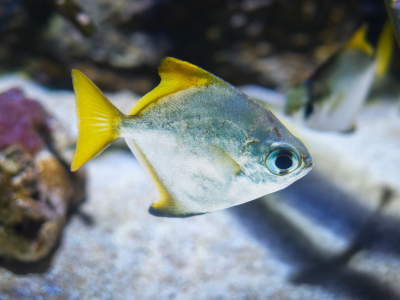
Monodactylus sebae
African Moony
Wissenschaftliche Klassifizierung
Schnellstatistiken
Aquarienbau-Informationen
Über diese Art
Dieser Inhalt ist derzeit nur auf Englisch verfügbar. Übersetzungen in andere Sprachen folgen in Kürze.
Grundbeschreibung
Detaillierte Beschreibung
The African Moony, Monodactylus sebae, is a striking brackish water species originating from the estuaries and mangrove swamps of coastal West Africa. Its unique, highly compressed diamond-shaped body makes it a showpiece fish. In captivity, recreating their natural environment is key to their success. This begins with water chemistry; they are euryhaline, meaning they adapt to a wide range of salinities. A specific gravity (SG) between 1.005 and 1.015 is ideal for long-term health, achieved by using marine salt mix, not table salt. Attempting to keep them in pure freshwater will lead to health problems and a shortened lifespan.
Due to their active nature and need to be kept in a school, a large aquarium is non-negotiable. While the given minimum is 200 liters, a larger tank of 400+ liters is highly recommended for a proper adult school. The aquascape should prioritize open swimming space in the mid and upper water columns. Decorations should be robust and water-proof, such as mangrove root replicas, lava rock, or tufa rock, which can also help buffer the water to maintain the required alkaline conditions. Live plants are often consumed, so hardy options like Anubias or Java Fern, or even artificial plants, are a safer choice.
Filtration must be robust. African Moonies have a high metabolic rate, leading to significant waste production and high oxygen demands. A powerful canister filter or a sump system is recommended to maintain pristine water quality and provide adequate water flow. Their social dynamic is critical; they are obligate schoolers. Without a group, they become timid, reclusive, and susceptible to disease. Their fast swimming and large size mean tank mates should be chosen carefully. Suitable companions include other robust brackish species like Archerfish (Toxotes jaculator), Scats (Scatophagus argus), or larger Columbian Sharks (Ariopsis seemanni). A varied, omnivorous diet is essential. Supplement a high-quality pellet or flake food with regular offerings of frozen foods like Mysis shrimp and brine shrimp, as well as plant-based matter like blanched spinach, nori, or spirulina wafers to fulfill their dietary needs.
Wissenschaftliche Beschreibung
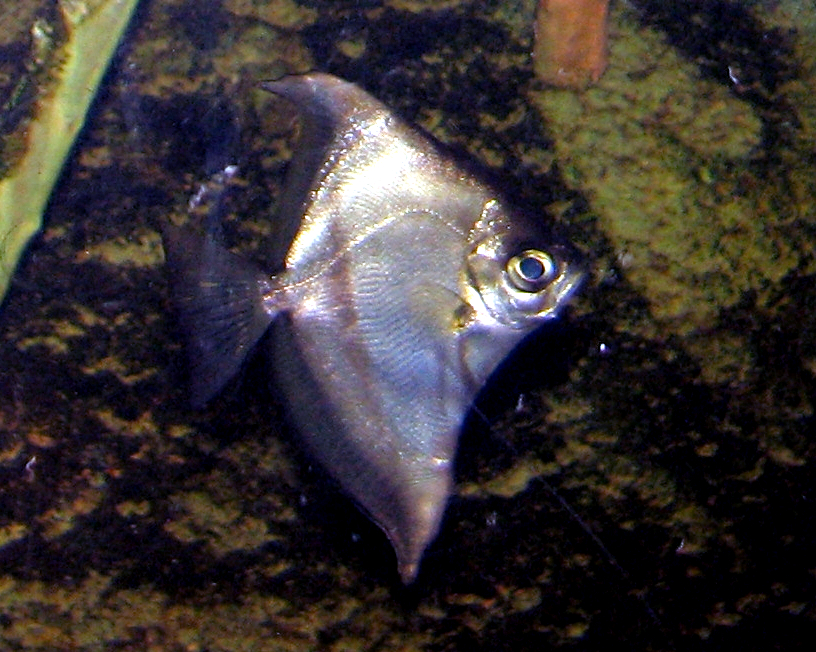
Monodactylus sebae is a member of the family Monodactylidae, characterized by its distinctive, highly compressiform body morphology. This deep, rhomboid body shape is an adaptation for high maneuverability, allowing for quick directional changes. Taxonomically, it is situated within the order Acanthuriformes. Native to the eastern Atlantic coast of Africa, its natural habitat consists of estuaries, lagoons, and mangrove ecosystems, which dictates its physiological requirements in an aquarium setting.
The species is notably euryhaline, exhibiting a wide tolerance for salinity fluctuations typical of estuarine environments. This physiological adaptation allows it to thrive in conditions from low-end brackish (approximately 2 ppt) to near-marine concentrations (up to 20 ppt). Correspondingly, it requires alkaline and hard water conditions to facilitate proper osmoregulation. The high combined oxygen consumption and waste production metrics are indicative of a species with a high metabolic load for its size, a consequence of its constantly active, pelagic schooling behavior. This necessitates a filtration system with a high turnover rate and substantial biological capacity to process the significant nitrogenous waste (high bioload) and ensure adequate gas exchange.
The 'difficult' breeding classification is due to its reproductive strategy. It is believed that M. sebae follows a pattern common to many estuarine fish, migrating to fully marine environments to spawn. The eggs and subsequent larvae are pelagic, drifting in the open ocean before the juveniles migrate back to the protective, lower-salinity estuaries to mature. Replicating this complex environmental cycle—involving separate, large-scale systems for spawning, larval rearing, and grow-out with varying salinities—is a significant challenge in aquaculture, making captive-bred specimens exceedingly rare. Its conservation status of 'Least Concern' (LC) by the IUCN reflects a stable and widespread wild population, meaning aquarium specimens are primarily wild-caught.
Druckbare Karte erstellen
Erstellen Sie eine druckbare Karte für dieses Tier zur Anzeige in Ihrem Geschäft oder Aquarium. Die Karte enthält einen QR-Code für schnellen Zugriff auf weitere Informationen.