Adinoacara rivulatus
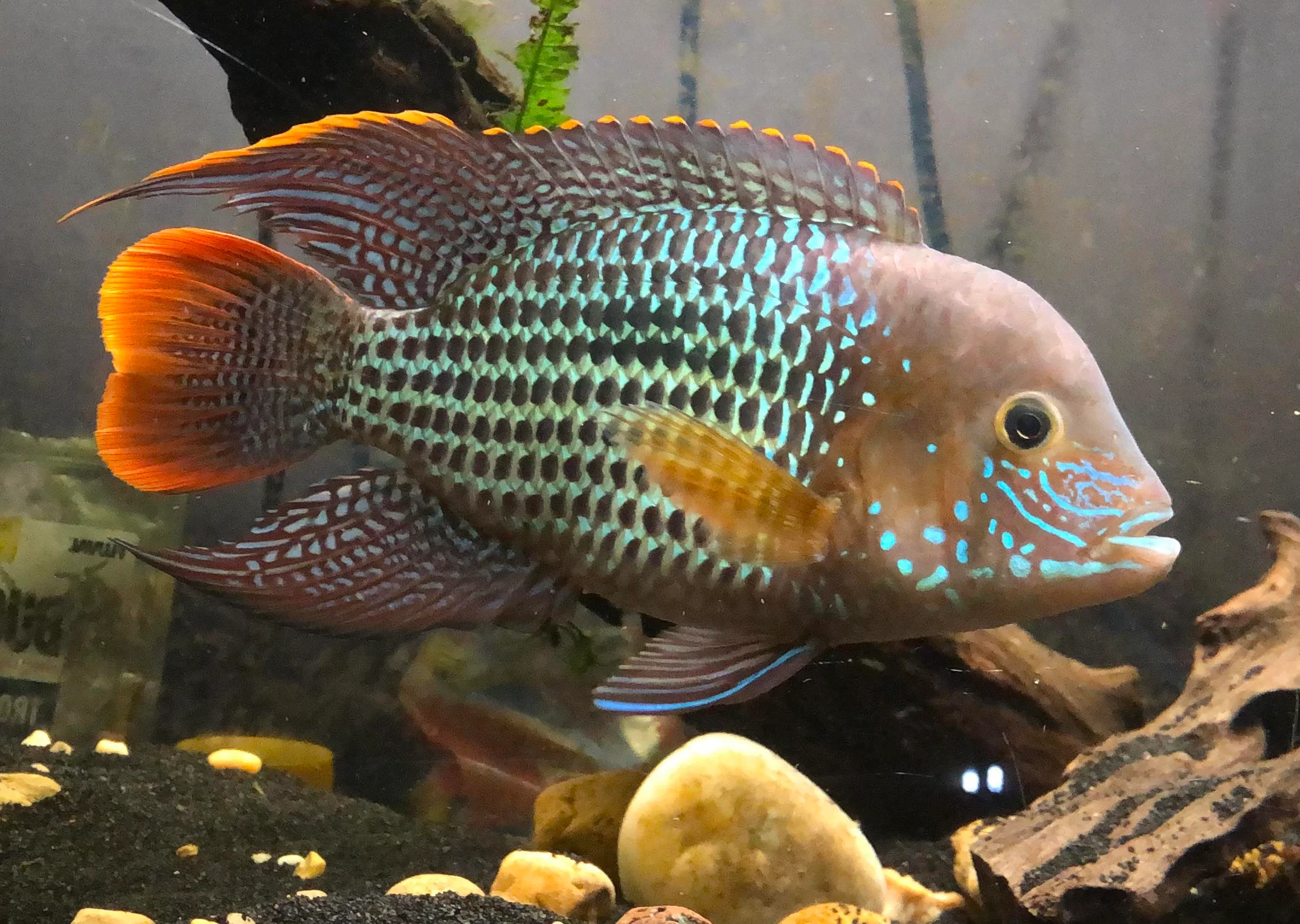
Green Terror Cichlid
Wissenschaftliche Klassifizierung
Schnellstatistiken
Aquarienbau-Informationen
Über diese Art
Dieser Inhalt ist derzeit nur auf Englisch verfügbar. Übersetzungen in andere Sprachen folgen in Kürze.
Grundbeschreibung
The Green Terror Cichlid, which also goes by the names Gold Saum or White Saum, is a beautiful and charismatic fish from South America. Despite its intimidating name, its aggression is often manageable if you provide it with enough space. These fish grow quite large, reaching up to 25 cm, and require a spacious aquarium of at least 210 liters to thrive. They are very active swimmers, exploring the middle and bottom levels of the tank.
As omnivores, they are not picky eaters and will readily accept a variety of foods including high-quality pellets, frozen items like bloodworms, and even some vegetables. A varied diet is key to bringing out their stunningly bright colors. They are known to be quite messy, producing a lot of waste, so a good filter is essential. With proper care, these hardy fish can be a centerpiece in your aquarium for up to 10 years. Because they are territorial, especially with their own kind, it's best to keep a single fish or a confirmed male-female pair. They are also known for digging in the substrate, so be mindful when choosing plants and decorations. They make for a very rewarding pet for an aquarist who is prepared for their size and personality.
Detaillierte Beschreibung
The Green Terror Cichlid, Adinoacara rivulatus, is a popular and striking fish among cichlid enthusiasts, hailing from the coastal river basins of South America. Its reputation for aggression is well-earned, but it's a manageable trait for an intermediate hobbyist prepared to meet its needs. The primary requirement is a large aquarium; a minimum of 210 liters is essential for a single adult, with significantly more space needed for a pair or a community setting. The tank should feature a fine sand or smooth gravel substrate to accommodate their natural digging behavior. This 'plant rooter' tendency means that delicate plants will likely be uprooted. If plants are desired, they should be robust species like Anubias or Java Fern securely attached to driftwood or rocks. Ample hiding places created with caves, rockwork, and driftwood are crucial to reduce stress and aggression by breaking lines of sight.
Water quality is paramount. These fish have a high metabolism and are heavy waste producers, resulting in a significant bioload. Therefore, powerful and efficient filtration, combined with regular weekly water changes of 25-40%, is non-negotiable to keep nitrates low. They prefer low-flow water conditions which mimic their natural habitat. While they can adapt to a wide pH and hardness range, stable parameters are more important than chasing exact numbers.
When it comes to tank mates, extreme care must be taken. Green Terrors are fiercely territorial, especially during breeding. They should not be kept with small, timid fish which will be bullied or eaten. Suitable companions include other large, robust, and semi-aggressive South American or Central American cichlids like Oscars, Jack Dempseys, or Acaras. It's often best to introduce them to the tank last to curb their territorial instincts. A varied omnivorous diet is essential for their health and vibrant coloration. A high-quality cichlid pellet should form the staple, supplemented frequently with frozen foods such as krill and bloodworms, live foods, and blanched vegetables like peas and spinach. Breeding can be moderately difficult. They form monogamous pairs and are substrate spawners, laying eggs on a cleaned flat rock. Parental care is excellent, but aggression levels skyrocket, often necessitating the removal of other tank mates.
Wissenschaftliche Beschreibung
The Green Terror Cichlid, assigned the binomen Adinoacara rivulatus, is a notable member of the Cichlidae family, originating from the Pacific-slope coastal drainages of South America, specifically in Ecuador and Peru. Its taxonomic classification places it within the order Cichliformes. This species was historically classified under the genus 'Aequidens', but was reclassified to 'Adinoacara'. Its IUCN Red List status is Least Concern (LC), indicating a stable and widespread population in its native range.
Physiologically, A. rivulatus is a robust species adapted to a range of freshwater environments. It tolerates a broad pH spectrum from 6.0 to 8.0 and water hardness spanning from 36 to 267 mg/L (approximately 2 to 15 dGH). Optimal husbandry involves maintaining temperatures between 20-25°C. Its high metabolism rate directly correlates with its high oxygen consumption and significant waste production. This results in a high bioload factor (16), necessitating advanced biological filtration and diligent aquarium maintenance to manage nitrogenous waste and maintain total dissolved solids below 300 ppm. The species exhibits low tolerance for salinity, with a maximum threshold of 0.5 ppt.
Behavioral ecology studies in aquaria reveal pronounced territoriality, which intensifies during breeding cycles. As a substrate-spawning cichlid, it engages in biparental care of its young. Its environmental interactions are significant; it is a known 'plant rooter', actively modifying its benthic environment by sifting and digging through the substrate. This behavior is linked to its foraging strategy as an omnivore, feeding on a wide variety of invertebrates, small fish, and plant matter in the wild. In captivity, its diet should reflect this omnivorous nature, comprising a mix of protein-rich prepared foods, live/frozen items, and vegetable matter to ensure proper nutrition. Swimming is predominantly in the middle and bottom water columns, consistent with its benthic and demersal habits. The common names 'Gold Saum' and 'White Saum' refer to distinct color morphs, distinguished by the coloration of the dorsal and caudal fin margins.
Druckbare Karte erstellen
Erstellen Sie eine druckbare Karte für dieses Tier zur Anzeige in Ihrem Geschäft oder Aquarium. Die Karte enthält einen QR-Code für schnellen Zugriff auf weitere Informationen.