Salvinia minima
Water Spangles
Scientific Classification
Quick Stats
Aquarium Building Information
About This Species
Basic Description
Water Spangles is an incredibly resilient and fast-growing floating plant, perfect for beginners looking to add natural cover and shade to their aquarium. This forgiving plant thrives on the water's surface, extending small, root-like structures downwards to absorb nutrients directly from the water column. Its ease of care is a major draw, as it does not require supplemental carbon dioxide, specialized lighting, or any substrate to grow. It is highly effective at improving water quality by consuming waste products, which in turn helps to control algae growth by outcompeting it for food.
Its dense surface coverage offers excellent shelter for fry, shrimp, and shy fish that prefer subdued lighting. The primary maintenance task is managing its rapid growth. You will need to periodically thin out the plant to prevent it from completely blocking light to plants below and to ensure proper oxygen exchange at the water's surface. It prefers still or gently moving water, as strong currents can push it underwater and cause it to perish.
Detailed Description
Water Spangles is a free-floating fern native to the Americas, widely appreciated in the aquarium hobby for its utility and straightforward care. This plant is exceptionally adaptable, capable of thriving in a broad spectrum of freshwater conditions, from cool, unheated tanks to warm, tropical setups. It is indifferent to water hardness and can tolerate a wide pH range, making it compatible with most aquarium environments without the need for specific water chemistry adjustments. Its lighting requirements are equally flexible; it can survive in low-light conditions but will exhibit more vigorous and compact growth under moderate to high illumination.
Ecologically, this plant is a powerhouse. Its high rate of nutrient absorption makes it an excellent tool for maintaining water quality. It rapidly consumes nitrates and phosphates, byproducts of fish waste and decaying organic matter, effectively reducing the bioload and naturally suppressing algae blooms. This process is directly linked to its very fast growth speed. As the plant photosynthesizes, it also contributes to oxygenating the water column. A key consideration for its placement is water flow. Its best performance is in tanks with minimal surface agitation, such as those housing labyrinth fish or equipped with gentle filtration, as strong currents or waterfall-style filter outflows can submerge and damage the delicate fronds. For aquarists, this plant provides a functional and aesthetic benefit, creating a natural, shaded environment that can reduce stress in timid fish and offer protection for juvenile inhabitants. Regular harvesting is essential to manage its spread and maintain open areas for light penetration and gas exchange.
Scientific Description
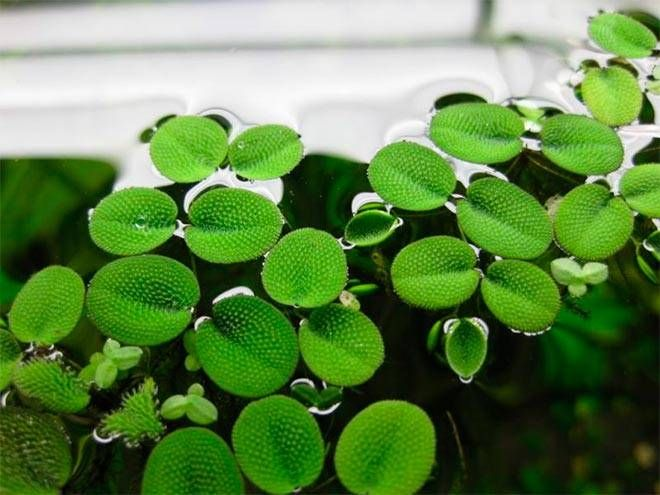
Salvinia minima is a small, free-floating aquatic fern belonging to the family Salviniaceae. This species is often confused with its larger, more invasive relative, Salvinia molesta. Morphologically, S. minima is characterized by its distinct structure. It possesses a horizontal, branching rhizome that floats just at or below the water's surface. From each node on the rhizome, three fronds (leaves) arise. Two of these are floating, ovate to circular fronds that are green and covered on their upper surface with unwettable, papillae-tipped hairs. These specialized trichomes trap a layer of air, providing buoyancy and repelling water. The third frond is submerged, finely dissected, and root-like in appearance and function. This submerged frond is the primary site of nutrient absorption from the water column, explaining the plant's lack of need for substrate and its high efficiency in water purification.
In its native habitat across the Americas, S. minima colonizes the surface of still and slow-moving freshwater bodies such as ponds, canals, and swamps. It forms dense mats that serve as a crucial habitat for various macroinvertebrates and provide shelter for small fish. Its rapid vegetative propagation allows it to quickly cover available surfaces, making it a significant primary producer in these ecosystems. This rapid growth and high nutrient uptake capacity have also led to its use in phytoremediation projects to remove excess nutrients from eutrophic waters. However, this same characteristic can make it an aggressive competitor, capable of shading out submerged native vegetation if its population is not controlled by natural factors. Its reproductive cycle is dominated by asexual fragmentation, where pieces of the rhizome break off and develop into new, genetically identical plants.
Reproduction Description
Propagating Water Spangles is exceptionally easy and typically occurs rapidly without any special effort from the aquarist. The primary method of reproduction in an aquarium setting is asexual, through vegetative fragmentation. The plant features a floating stem, or rhizome, that continuously grows and branches out along the water's surface. As the plant matures and expands, these branches naturally break apart, or can be manually separated, to form new, independent plants.
To propagate it, simply scoop out a small section of the plant containing at least a few leaves and a piece of rhizome and place it in a new aquarium or a different area of the same tank. Even a single, small fragment will quickly establish itself and begin to multiply. Successful propagation is influenced by environmental conditions; growth is most vigorous in water with available nutrients, such as nitrates and phosphates, and under moderate to intense lighting. While it will still grow in lower light and nutrient-poor water, its rate of reproduction will be significantly slower. No specialized equipment, such as CO₂ injection or specific substrates, is required.
There is no special care needed for newly separated plantlets, as they are simply smaller versions of the parent plant. The most critical factor is ensuring they are placed in an area with low surface agitation, as strong currents can be detrimental. The main challenge with this species is not encouraging propagation but controlling it. Regular thinning is necessary to prevent it from forming an impenetrable mat that blocks all light from reaching submerged plants and hinders gas exchange at the surface.
Generate Printable Card
Create a printable card for this creature to display in your store or aquarium. The card includes a QR code for quick access to more information.