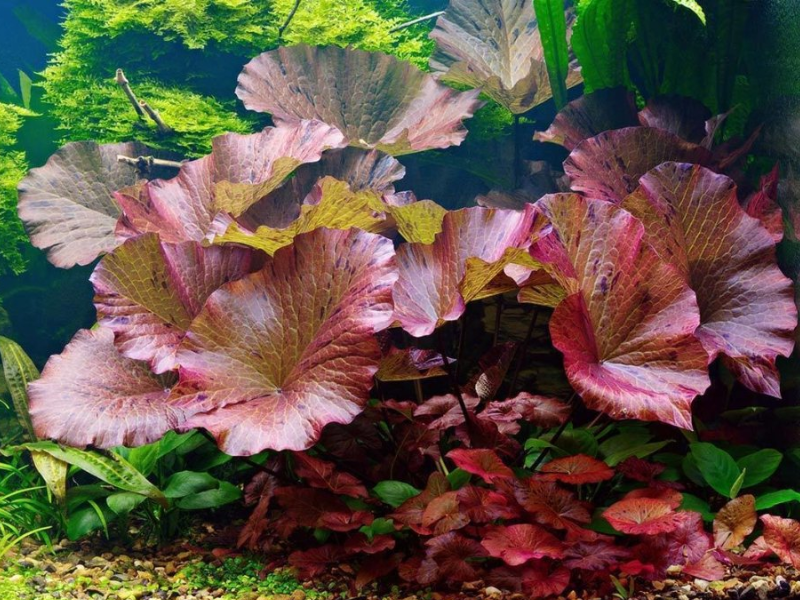
The Tiger Lotus is a stunning aquatic lily that develops from a bulb, producing large, arrow-shaped underwater leaves and round surface-level lily pads. This fast-growing plant adds a dramatic focal point to the background of an aquarium, with its leaves reaching impressive heights under the right conditions. Originating from freshwater habitats in Africa and Asia, it's a popular choice for hobbyists looking to create a natural-looking environment. While it is adaptable, it thrives best with moderate to strong lighting, which encourages vibrant growth. It prefers to be planted in a soft substrate like sand or specialized aquatic soil, where its roots can anchor and absorb nutrients. The plant's care is considered moderately difficult, making it a rewarding project for aquarists who have some experience. Its rapid growth helps consume excess nutrients in the water, contributing to a cleaner and more stable aquatic ecosystem. Regular pruning of the floating leaves can encourage it to grow more densely underwater, creating a bushier appearance.
Detailed Description
The Tiger Lotus is a versatile and aesthetically striking plant highly valued in the aquascaping community. It is a bulb plant that exhibits two distinct growth forms depending on environmental conditions. With moderate lighting, it tends to focus its energy on producing broad, submerged leaves, creating a lush, bushy appearance in the background of the tank. Under high-intensity lighting, the plant will readily send long stems to the surface to produce floating lily pads, which can provide shade and a sense of security for fish below. This behavior can be controlled through regular pruning of the floating leaves to encourage a more compact, submerged form. This species thrives in warmer, slow-moving freshwater, reflecting its native tropical environment. It is adaptable to a wide range of water acidity and hardness but prefers stable parameters. As a heavy root feeder, its success is highly dependent on the substrate. A nutrient-rich substrate, such as aquarium soil or sand enhanced with root-fertilizer tabs, is essential for providing the sustenance it needs for its rapid growth. This high nutrient demand makes the Tiger Lotus an excellent tool for nutrient export, as it effectively absorbs nitrates and phosphates from the water column, helping to reduce the biological load and compete with algae. While it does not strictly require carbon dioxide injection, providing supplemental CO₂ will result in more vigorous growth, larger leaves, and an overall more robust plant. Due to its potential size, it is best suited for larger aquariums where it has ample space to expand both vertically and horizontally.
Scientific Description
Nymphaea lotus, a member of the Nymphaeaceae family, is a perennial aquatic herb with a wide distribution across tropical and subtropical regions of Africa and Asia. Its taxonomic status is firmly validated. Morphologically, the plant is characterized by a starchy, subterranean tuber from which it sprouts. It exhibits leaf dimorphism: submerged leaves are typically sagittate or heart-shaped with wavy margins, thin, and somewhat translucent, while the floating leaves are orbicular or peltate with a cleft at the base, thicker, and more leathery to withstand surface tension and exposure. The long, flexible petioles allow the leaves to adjust to varying water depths. This species is a high-oxygen producer, contributing significantly to the dissolved oxygen content of its environment through photosynthesis. Ecologically, it plays a crucial role in its native habitats. The broad lily pads provide extensive shade, which moderates water temperature and limits light penetration, thereby controlling the growth of subordinate algae and other submerged plants. These pads also offer shelter and foraging grounds for invertebrates and small fish. Nymphaea lotus is an efficient nutrient sink, demonstrating a high capacity for absorbing nitrogenous and phosphatic compounds from the sediment and water column. This rapid nutrient uptake helps maintain water clarity and reduces eutrophication. Its conservation status is listed as Least Concern (LC) by the IUCN, reflecting its widespread population and adaptability to various freshwater ecosystems, provided they have a soft, nutrient-rich bottom and low water flow.
Reproduction Description
Propagation of the Tiger Lotus is moderately easy and can be achieved through both sexual and asexual methods, though asexual reproduction is far more common and practical in an aquarium setting. The plant naturally reproduces asexually by producing new, smaller tubers (daughter bulbs) around the base of the main parent bulb. Successful propagation is heavily influenced by environmental conditions; a nutrient-rich substrate, medium to high lighting, warm water, and stable parameters will encourage the plant to invest energy into forming these new tubers. Once a daughter bulb has formed and developed its own small leaves and a rudimentary root system, it can be separated for planting. To do this, gently unearth the parent plant and carefully detach the smaller tuber. Handle the delicate roots with care to avoid damage. Plant the new tuber in the substrate, ensuring that the top portion where leaves emerge remains slightly exposed. Burying the bulb completely can lead to rot. The newly planted tuber will establish itself over several weeks, drawing energy from its reserves to produce new roots and leaves. Providing root-tab fertilizers near the new plant can accelerate its establishment and promote vigorous growth. Be patient, as it may shed its initial leaves while it acclimates to its new position. Avoid frequent movement once planted to allow the root system to develop undisturbed.