Bucephalandra pygmaea
Pygmy Bucephalandra
Scientific Classification
Quick Stats
Aquarium Building Information
About This Species
Basic Description
Detailed Description
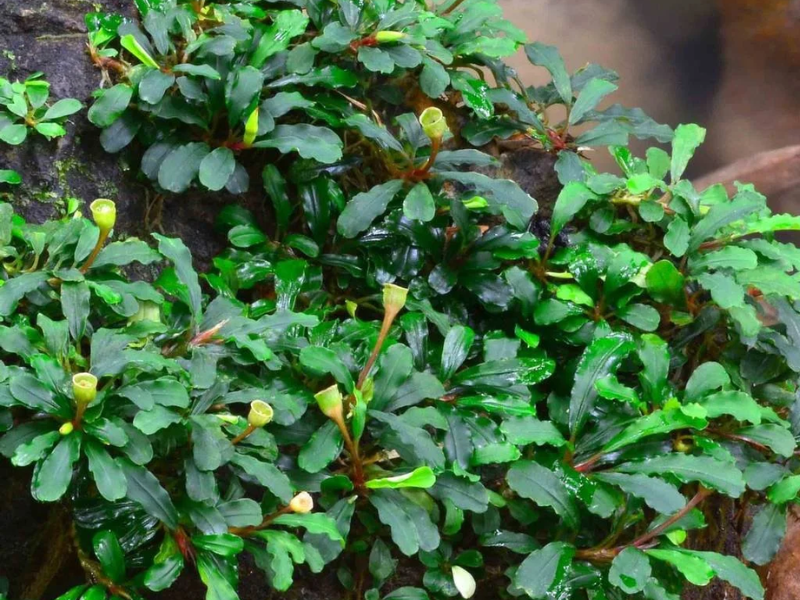
Pygmy Bucephalandra, often referred to by its genus name 'Buce,' is a fascinating rheophytic plant native to the waterways of Asia. Its classification as a rheophyte means it is naturally adapted to living in areas with constant, flowing water. In an aquarium, this translates to a preference for gentle to moderate water circulation, which helps deliver nutrients and keeps debris from settling on its leaves. This plant is an epiphyte, meaning its entire life cycle is spent attached to surfaces like stones and wood. The primary rule for its care is never to bury the rhizome—the horizontal, creeping stem from which leaves and roots grow—as this will lead to irreversible rot. Attachment can be achieved using cyanoacrylate superglue gel or by tying it with cotton thread until its roots have firmly anchored themselves.
The 'medium' difficulty rating stems not from demanding requirements, but from its sensitivity to instability. Sudden shifts in water parameters, lighting, or nutrient levels can trigger a stress response known as 'melting,' where the plant's leaves rapidly disintegrate. However, a healthy rhizome will often sprout new leaves once conditions stabilize. It is highly adaptable to a variety of lighting conditions, thriving in less intense light but showing more robust, compact growth under moderate illumination. While it will grow without CO₂ injection, providing it can significantly improve its health, resilience against algae, and overall appearance. As a slow-growing species, its nutrient uptake is minimal. It benefits more from a comprehensive liquid fertilizer dosed into the water column than from nutrient-rich substrates, as it primarily absorbs food through its leaves. Its very slow growth makes it exceptionally low-maintenance, perfect for aquascapes where stability and minimal pruning are desired.
Scientific Description
Bucephalandra pygmaea is a flowering perennial from the Araceae family, a group it shares with other popular aquatic genera like Anubias and Cryptocoryne. Originating from the island of Borneo in Asia, it is ecologically classified as a rheophyte, specifically adapted to the dynamic environment of fast-flowing streams and rivers. Its morphology is a clear reflection of this habitat. The plant grows from a strong, creeping rhizome that firmly anchors it to hard surfaces, preventing it from being washed away by strong currents. Its roots are primarily for anchorage rather than nutrient absorption. The leaves are typically hardy and possess a waxy cuticle, which helps reduce desiccation during periods of emersed growth when water levels recede.
Like other aroids, B. pygmaea is capable of producing an inflorescence, which consists of a spathe and spadix. This can occur both in submersed and emersed conditions, though successful pollination and seed set in an aquarium are exceedingly rare. The plant's slow metabolism is a key physiological trait, contributing to its very slow growth rate, low demand for light, and minimal nutrient requirements. This conservative growth strategy is an adaptation to the often nutrient-poor and light-limited conditions found in the shaded forest streams it inhabits. In its native ecosystem, colonies of Bucephalandra play a role in stabilizing sediment and providing complex microhabitats for aquatic invertebrates and small fish. The well-documented 'melting' phenomenon observed in aquarium cultivation is a stress-induced senescence, where the plant sheds its leaves in response to environmental shock, conserving energy in the rhizome to regenerate when conditions become favorable again.
Reproduction Description
Propagating Pygmy Bucephalandra is a relatively simple process, though it requires significant patience due to the plant's characteristically slow growth rate. This species reproduces almost exclusively through asexual means in an aquarium setting, specifically via rhizome division. While it is a flowering plant capable of sexual reproduction, achieving this in a home aquarium is impractical and rare.
To propagate the plant, begin with a healthy, mature specimen that has a well-developed rhizome with several clusters of leaves. Using a sharp, sterilized blade or pair of scissors, carefully cut the rhizome into two or more sections. It is crucial to ensure that each new division has at least a few healthy leaves and, if possible, some established roots. This greatly increases the new plantlet's chance of survival and successful establishment. After cutting, the new divisions should be attached to a piece of hardscape, such as a rock or piece of driftwood. This can be done using a small amount of cyanoacrylate superglue gel or by tying it loosely with fishing line or cotton thread. Never bury the rhizome in the substrate, as this will cause it to rot.
Successful propagation depends heavily on stable environmental conditions. Avoid any drastic changes in water chemistry, temperature, or lighting, as new cuttings are particularly susceptible to melting. The plantlets will establish best under low to moderate lighting and in an area with good water circulation, which prevents debris from settling on the leaves and aids in nutrient delivery. Since this plant feeds from the water column, provide a consistent supply of a balanced liquid fertilizer to support new root and leaf development. Be patient, as it can take several weeks or even months for a new cutting to show visible signs of new growth. To ensure a high success rate, avoid dividing a plant until it is well-established and only take divisions that are large enough to be self-sustaining.
Generate Printable Card
Create a printable card for this creature to display in your store or aquarium. The card includes a QR code for quick access to more information.