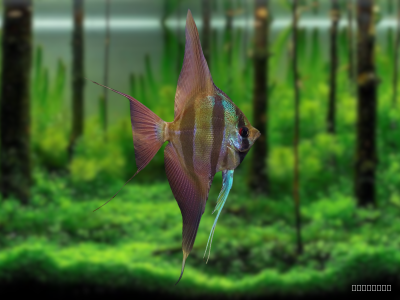
Pterophyllum scalare
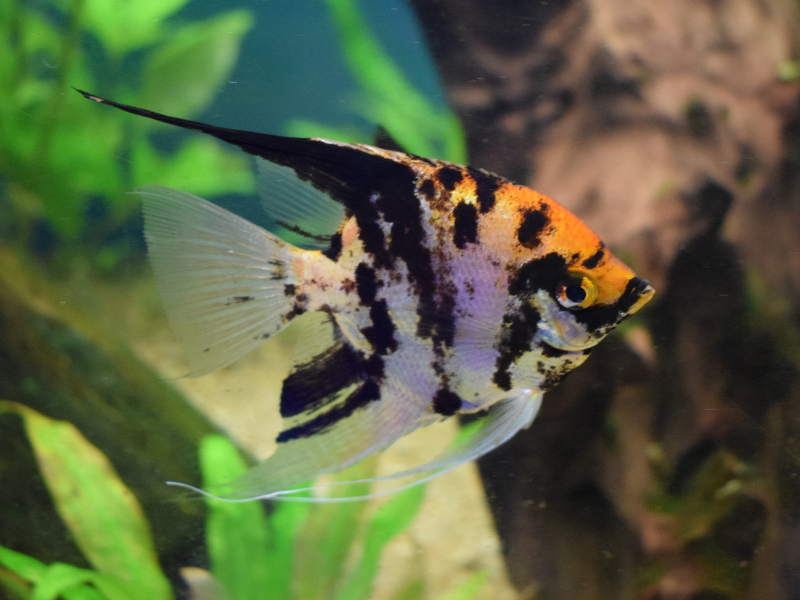
var. Koi
Scientific Classification
Origin
Quick Stats
Aquarium Building Information
About This Species
Basic Description
Detailed Description
Native to the slow-moving rivers and flooded forests of South America, the Freshwater Angelfish has adapted to a specific environment that should be emulated in a home aquarium. In the wild, they navigate through dense tangles of submerged roots and aquatic plants, which explains their preference for a well-structured tank with plenty of vertical decorations like driftwood and tall plants. This setup not only provides security but also offers surfaces for potential breeding. Their laterally compressed bodies are perfectly designed for maneuvering in these complex habitats. They prefer soft, slightly acidic water with very low flow, as strong currents can cause them stress.
As a schooling species, a group should be established to allow for the development of a natural social hierarchy, often called a 'pecking order.' This reduces aggression among individuals. In an aquarium, they primarily inhabit the middle and upper water columns. While generally peaceful, their cichlid nature means they are territorial, especially as they mature and form breeding pairs. This territoriality can lead to conflicts if the tank is overcrowded or lacks sufficient hiding spaces. Caution is advised when selecting tank mates; very small, slender fish may be mistaken for prey, and fast, fin-nipping species should be avoided to protect their delicate fins.
A varied omnivorous diet is crucial for their health and long lifespan. The cornerstone of their diet should be a high-quality pellet or flake, but this must be supplemented regularly with frozen or live foods to provide essential proteins and nutrients. Their moderate metabolism requires daily feedings. Due to their medium waste production, a robust filtration system and consistent water change schedule are necessary to maintain the pristine water conditions they require. When cared for properly in a spacious, tall aquarium that accommodates their adult size, these elegant fish can live for many years, becoming a long-term centerpiece.
Scientific Description
Pterophyllum scalare is a species belonging to the family Cichlidae, endemic to several river basins in South America. Its most distinguishing morphological feature is its compressiform, or laterally compressed, body shape. This deep, disc-like profile, combined with elongated dorsal and anal fins, is an evolutionary adaptation for navigating the dense aquatic vegetation and submerged woody debris of its natural flood-plain habitat. This body plan reduces its hydrodynamic profile when viewed from the front, aiding in both ambush predation and evasion.
Physiologically, the species is adapted to warm, soft, and slightly acidic freshwater environments characterized by low total dissolved solids and negligible salinity. Its osmoregulatory system is efficient in these conditions but can be stressed by hard, alkaline water or abrupt changes in water chemistry. It exhibits a medium metabolic rate and corresponding oxygen consumption, requiring well-oxygenated water but being intolerant of high-flow conditions typical of river rapids. As an omnivore, its diet in situ consists of small crustaceans, insect larvae, worms, and some vegetative matter. Its social structure is based on schooling, particularly in juveniles, which transitions to pair-bonding and territoriality in adulthood. This territorial behavior is a pronounced sociobiological trait, essential for resource competition and reproductive success.
In an aquacultural context, P. scalare has a moderate bioload factor. Its waste production is consistent with its size and metabolic rate, necessitating adequate biological filtration to process nitrogenous wastes and maintain water quality. Its classification by the IUCN as Not Evaluated (NE) indicates a lack of formal assessment on a global scale, though its widespread distribution and high prevalence in aquaculture suggest it is not under immediate threat.
Breeding Description
Breeding Freshwater Angelfish is considered moderately difficult but is a highly rewarding endeavor for a dedicated hobbyist. This species forms monogamous, long-term pairs, and the most effective method for obtaining a compatible pair is to raise a group of at least five or six juveniles together and allow them to select their own mates naturally. Forcing a pair is rarely successful.
Sexing individuals is notoriously challenging, especially when they are young. As they reach sexual maturity, some subtle differences may emerge. Males sometimes develop a small, rounded nuchal hump on their forehead, and their overall body size might be slightly larger. The most reliable method of identification is to observe the genital papillae, or breeding tubes, which become visible just before spawning. The male's tube is small, thin, and pointed, while the female's is noticeably thicker, blunter, and more triangular, designed for depositing eggs.
As egg-layers, they exhibit dedicated biparental care. Once a pair is ready to spawn, they will select and meticulously clean a vertical or slanted surface, such as a broad plant leaf, a piece of slate, or even the aquarium glass. The female will then lay her adhesive eggs in neat rows, with the male following closely behind to fertilize them. After spawning, both parents will guard the eggs aggressively, fanning them with their pectoral fins to provide oxygen and prevent fungal growth. They will also remove any unfertilized eggs that turn white.
The eggs typically hatch in a few days, at which point the parents will move the wriggling larvae to a new, clean location. The fry will remain attached to this surface, absorbing their yolk sacs for several more days. Once they become free-swimming, they must be fed microscopic foods like infusoria or newly hatched brine shrimp multiple times a day. The parents will continue to protect the school of fry, though it is not uncommon for inexperienced pairs to consume their first few broods due to stress or other factors. For this reason, some breeders opt to artificially hatch the eggs in a separate container.
Related Images
Koi
Generate Printable Card
Create a printable card for this creature to display in your store or aquarium. The card includes a QR code for quick access to more information.