Oryzias woworae
Daisy's Ricefish
Scientific Classification
Quick Stats
Aquarium Building Information
About This Species
Basic Description
Detailed Description
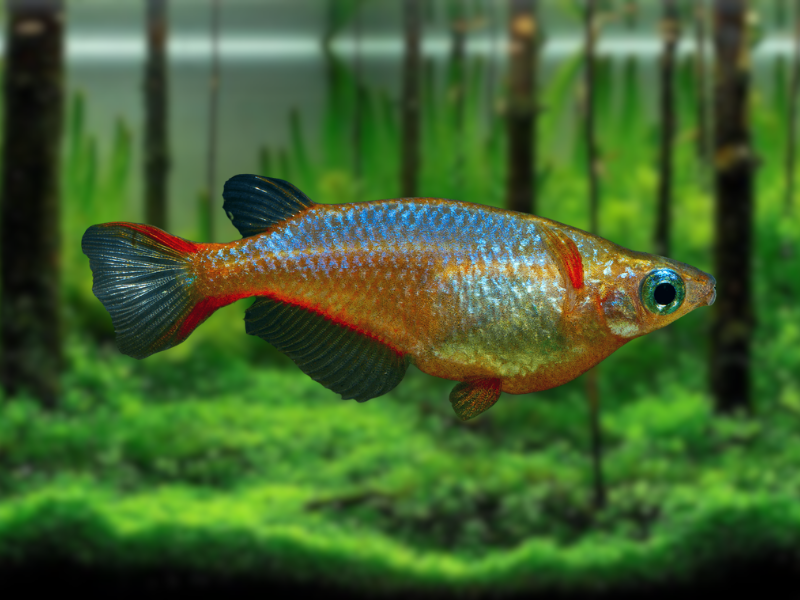
Oryzias woworae, commonly known as Daisy's Ricefish or Wowora's Ricefish, is a small, captivating species originating from Asia. Its natural habitats consist of slow-moving, clear freshwater bodies, which should be replicated in the aquarium to ensure its well-being. A successful setup for these fish involves an aquarium with low water flow, which can be achieved using a gentle sponge filter or by baffling the output of a canister or hanging filter. While they can be housed in smaller tanks, a longer aquarium is preferred to provide ample swimming space for an active school. A dense planting scheme, especially with floating plants and fine-leaved vegetation, will mimic their natural environment, providing security and surfaces for grazing, as they are known to consume biofilm.
Water parameters should be kept stable, although this species is adaptable to a moderate range of pH and hardness. As a strictly freshwater fish, any salinity should be avoided. The most critical aspect of their housing is a tightly-fitting lid, as their active, top-dwelling nature makes them prone to jumping. Their social behavior is a key aspect of their care; they are a true schooling fish and should be kept in a group of at least eight, with larger groups being highly beneficial. A proper school not only reduces stress but also encourages more dynamic and natural interactions. In a community setting, they are peaceful and should only be housed with other small, mild-mannered species that will not intimidate or outcompete them for food. Their diet is omnivorous and should be varied. A high-quality micro-pellet or crushed flake can serve as a staple, supplemented regularly with frozen and live foods to promote optimal health and coloration. With a relatively low metabolism and waste production, their impact on the bioload is minimal, but consistent water quality maintenance is still paramount for their long-term health and to reach their typical lifespan.
Scientific Description
Oryzias woworae is a validated species within the family Adrianichthyidae, belonging to the order Beloniformes. Its taxonomic classification is as follows: Kingdom Animalia, Phylum Chordata, Class Actinopterygii, and Genus Oryzias. As a member of the 'ricefish' genus, it exhibits many of the signature traits of this group, including a small adult size and a preference for surface-dwelling.
Morphologically, O. woworae possesses a fusiform, or torpedo-shaped, body plan. This streamlined shape is an adaptation for its active swimming behavior and maneuverability in the upper water column. Physiologically, it is characterized by a low metabolism, low oxygen consumption, and consequently, low waste production, which gives it a modest bioload factor in a captive environment. It is a stenohaline freshwater species, with a very low tolerance for salinity, and thrives in tropical temperatures. Its adaptability to a range of pH and water hardness levels suggests it may originate from environments with some seasonal fluctuation. Its diet is classified as omnivorous, and in its natural ecology, it likely feeds on zooplankton, small invertebrates, insect larvae, and aufwuchs or biofilm. This biofilm consumption is a notable environmental interaction. The species' conservation status is listed as Vulnerable on the IUCN Red List. This designation indicates a high risk of extinction in the wild, placing a significant importance on understanding its biology and establishing sustainable captive breeding populations for ex-situ conservation and to reduce pressure on wild populations.
Breeding Description
Breeding Oryzias woworae is a project of moderate difficulty, readily achievable for the dedicated aquarist. The process begins with conditioning a healthy group of adults. To encourage spawning, provide a diet rich in live and frozen foods. A recommended ratio for a breeding group is two to three females for every one male, which disperses spawning attention and reduces stress on individual females. Sexual dimorphism is subtle but discernible; males typically display extensions on their dorsal and anal fins and may exhibit more intense coloration, especially when posturing for females. Females, particularly when gravid, will appear fuller and more rounded in the abdominal area.
This species belongs to the 'egg-hanger' group of ricefish. Following a spawning event, the female will carry a cluster of adhesive eggs near her vent for several hours before depositing them onto a suitable surface. Therefore, the breeding aquarium should be furnished with fine-leaved plants, such as Java Moss or Cabomba, or with artificial spawning mops made of acrylic yarn. These mops serve as an ideal, easily removable medium for egg collection. To maximize fry yield, the spawning medium with the attached eggs should be transferred to a separate, dedicated rearing tank. This tank should contain water from the main aquarium and be equipped with a gentle sponge filter to provide oxygenation without creating a harmful current. The eggs typically hatch after one to two weeks, depending on the water temperature. Once the fry are free-swimming and have fully absorbed their yolk sacs, they must be fed microscopic foods. Infusoria, liquid fry food, and powdered foods are excellent initial options. As they grow over the first week, they can be transitioned to larger foods like live vinegar eels and newly hatched brine shrimp. Maintaining pristine water quality through small, frequent water changes is crucial for the survival and healthy development of the delicate fry.
Generate Printable Card
Create a printable card for this creature to display in your store or aquarium. The card includes a QR code for quick access to more information.